PMS Punjab
New PMS Syllabus 2027: Compulsory Subjects and Preparation
PPSC’s revised PMS scheme gives compulsory papers 1,000 marks. Understand each subject’s syllabus, what a strong attempt requires, and how to begin preparation.
Your old PMS timetable needs a rethink. Under PPSC’s revised scheme for the Combined Competitive Examination expected in 2027, ten compulsory papers carry 1,000 marks, while one optional subject carries 100. Compulsory preparation now needs much more space in your week.
The new PMS syllabus also requires closer reading than a list of paper titles. Pakistan Studies-I includes institutions and governance alongside history. General Knowledge still includes mathematics and languages. PPSC now provides a guidebook for Mental Ability and Reasoning.
This guide explains the PPSC PMS exam syllabus and gives you a practical starting task for every compulsory paper. Official requirements and our preparation suggestions are identified separately.
The linked CSS resources support overlapping topics and writing skills. Match their coverage to PPSC’s outline and follow PMS instructions for timing, length and marks.
PPSC public notice
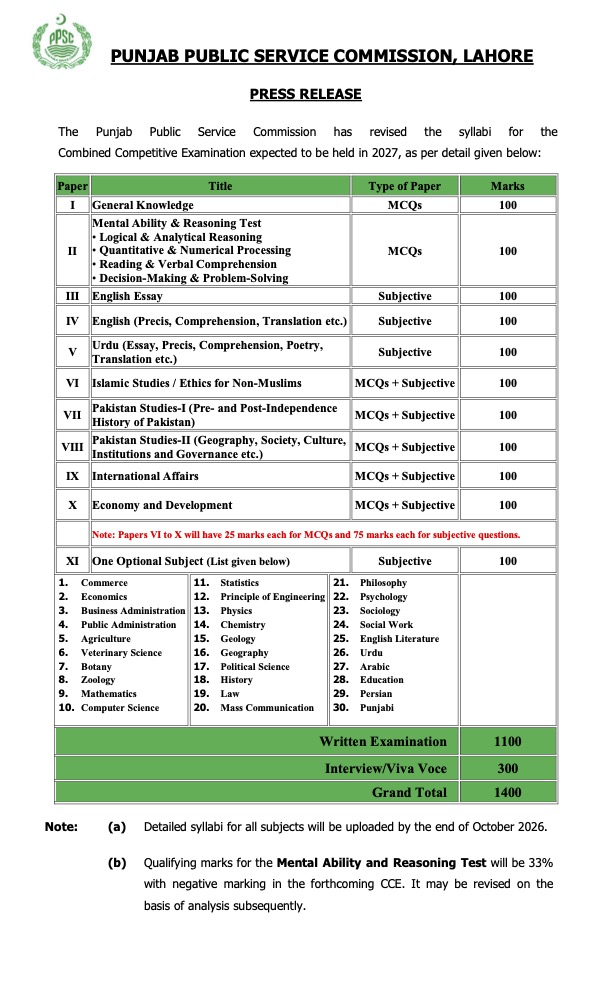
Read the official PPSC press release alongside the compulsory syllabus downloads.
Link and Mental Ability update: 13 November 2026. The subject downloads below use PPSC’s current links. The Mental Ability and Reasoning guidebook is now available.
In this guide
PPSC PMS exam new format: papers and marks
The revised scheme shifts the written examination from six compulsory papers and three optional subjects to ten compulsory papers and one optional subject.
- Compulsory papers: ten papers of 100 marks each, totalling 1,000.
- Optional subject: one subject carrying 100 marks.
- Written examination: 1,100 marks.
- Interview/viva voce: 300 marks.
- Overall total: 1,400 marks.
General Knowledge and Mental Ability are MCQ papers. English Essay, English and Urdu are subjective. Papers VI to X each contain 25 marks of MCQs and 75 marks of subjective questions.
The notice describes an examination expected in 2027. It does not announce an examination date. For a shorter overview, see our revised PMS Punjab exam pattern guide.
PMS exam compulsory subjects: what to prepare
Each paper below carries 100 marks. Use the linked PDFs for the complete outlines; the summaries identify their main areas. Several syllabi describe their topic lists as indicative rather than exhaustive.
1. General Knowledge (Paper I)
Format: objective paper, 90 minutes.
Analysis highlight: this paper requires broad knowledge, accurate recall and basic calculation under time pressure. Revise science, languages and mathematics alongside current affairs.
The General Knowledge syllabus covers eleven broad areas:
- Current affairs, Pakistan’s relations and major global issues.
- Physical sciences, including energy, materials and natural hazards.
- Biological sciences, including health, genetics and ecosystems.
- Environmental studies, including smog, water and climate commitments.
- Food science, nutrition, preservation and safety.
- Computers and IT, including Office applications, AI and information security.
- Mathematics, including arithmetic, algebra, geometry, matrices and basic statistics.
- Scientists, discoveries, inventions, units and instruments.
- English grammar and vocabulary.
- Urdu usage, grammar, idioms and proverbs.
- Islamic Studies general knowledge.
How to prepare: divide your revision by these areas. After each MCQ set, record the mistake, the correct explanation and when you will revisit it. Do calculations on paper rather than memorising answer options.
For overlapping topics, use our free MPT preparation resources, including practice tests and mock papers, to strengthen recall and practise MCQs, while checking your coverage against the PPSC General Knowledge syllabus.
Try this: attempt a small mixed set. Are your errors concentrated in science, mathematics or language? Let that result determine tomorrow’s revision.
The new reasoning paper does not remove mathematics from GK.
2. Mental Ability and Reasoning (Paper II)
Format: MCQs. Read PPSC’s Mental Ability and Reasoning guidebook for the competencies, sample questions and explanations.
Analysis highlight: this paper tests how you work with information and choose a sound response, not just what you can recall. Its four areas are:
- Logical and analytical reasoning: ordering, grouping, schedules, patterns and deductions from stated constraints.
- Quantitative and numeric processing: percentages, ratios, budgets, resource allocation, tables, charts and checking numerical accuracy. The emphasis is practical numerical reasoning, not advanced mathematics.
- Reading and verbal comprehension: meaning in context, main ideas, conditions, exceptions, relationships between statements and justified inferences.
- Problem-solving and decision-making: workplace priorities, risks, ethics, policies, communication and knowing when to escalate a problem.
PPSC says the guidebook is non-exhaustive. Its examples illustrate the approach; they do not limit what can be asked within these four areas.
The earlier press release specifies 33% qualifying marks with negative marking for the forthcoming CCE, subject to possible later revision following analysis. The guidebook does not give a deduction per wrong answer. Check the applicable examination instructions rather than assuming a penalty rate.
How to prepare: work through the official examples, explain why each rejected option fails, then practise fresh questions of the same type. Use grids for logic, show your calculations, and underline conditions in reading passages. For workplace scenarios, identify the problem, applicable rule and risk before selecting an action. Build accuracy before speed.
Try this: a price rises from Rs 800 to Rs 1,000. The increase is 25%, calculated against the original Rs 800.
3. English Essay (Paper III)
Format: subjective, two hours and thirty minutes.
Analysis highlight: demonstrate a clear understanding of one topic through a sustained, logically organised discussion. Every paragraph should develop the argument in accurate, readable English.
The English Essay PDF requires an essay of about 1,500 words. It assesses understanding of the topic, conceptual clarity, logical reasoning, expression and correct English.
How to prepare: practise interpreting the exact wording before drafting. State your position, arrange supporting claims and choose evidence that proves each claim. An outline headed “education, economy, politics” is less useful than headings explaining what each factor does.
For a practice topic on technology and education, ask: does the prompt require benefits, limitations or an argument about access? Your outline should answer that question.
Write full essays under the stated time limit. Include planning and proofreading within that period. Treat the 1,500-word requirement as an instruction to develop a focused argument.
Read our essay-writing guide for the shared method, while keeping the PMS requirements above.
Know the topic, but struggle to build the essay? Preview the Essay Writing Handbook for thesis statements, outlines, paragraphs and worked examples.
Prefer to see the method explained? Explore the Essay and Précis Writing Masterclass. Watch the free trial before choosing the paid course.
4. English language paper (Paper IV)
Format: subjective, three hours.
Analysis highlight: this paper requires control of meaning and language: accurate compression, passage-based answers, precise correction and faithful translation. Practise each task separately before combining them.
The English language syllabus gives this indicative distribution:
- Précis writing and a suitable title: 20 marks.
- Comprehension, with five passage-based questions: 20 marks.
- Grammar and vocabulary: 20 marks.
- Sentence correction: 10 marks.
- Grouping words, word pairs and related vocabulary tasks: 10 marks.
- Urdu-to-English translation: 20 marks.
PPSC states that these component marks are indicative and subject to change.
How to prepare: rotate between summarising, comprehension, correction and translation. In a précis, preserve the author’s argument without adding your opinion. For comprehension, answer from the passage. In sentence correction, repair the error without unnecessary rewriting.
Try this: translate a short Urdu paragraph, then check meaning, tense and idiomatic expression separately. A grammatically correct translation can still distort the original.
Use our step-by-step précis guide to practise the method.
Practise first, then compare. The Précis Writing Handbook provides eleven practice passages and worked solutions. Attempt a passage before opening its solution.
Build vocabulary you can use. Open Words That Work, the free English Vocabulary Bank. Revise synonyms and antonyms, then use five words in sentences of your own.
5. Urdu (Paper V)
Format: subjective, three hours.
Analysis highlight: show organised thinking in the essay and accuracy across shorter language tasks. Your preparation must build written fluency and allow time for the whole paper.
The detailed Urdu syllabus includes:
- An Urdu essay of about 1,000 words.
- Précis writing with a suitable title.
- Comprehension with five passage-based questions.
- Grammar, vocabulary, sentence correction and word relationships.
- English-to-Urdu translation, including idiomatic expressions.
Essay areas include education, the economy, environment, governance, rights and other Pakistani or general issues.
How to prepare: write Urdu regularly by hand. Practise clear paragraphs, accurate spelling and natural expression. Plan for the essay alongside the other tasks within three hours; conversational fluency alone will not establish that you can finish.
Important document difference: the press release includes poetry in the paper title, while the detailed Urdu PDF does not list a separate poetry component. Do not assume poetry has been formally removed. Check subsequent PPSC clarification and applicable paper instructions.
Our PMS Urdu preparation guide offers writing practice; read it alongside the revised outline and this document difference.
6. Islamic Studies (Paper VI)
Format: 25 marks of MCQs and 75 marks of subjective questions.
Analysis highlight: combine factual knowledge with an explanation of Islamic principles and their application. Select relevant references and explain their connection to the question.
The Islamic Studies syllabus covers:
- Beliefs, practices and Islam’s individual and social effects.
- Seerat, including the Prophet’s roles in education, administration and diplomacy.
- The Prophetic period and the Rightly Guided Caliphs.
- Human rights, women, minorities and Maqasid-ul-Shariah.
- Islam’s relationship with the modern world and contemporary challenges.
- Islamic social, political, economic, judicial and administrative systems.
- Sources of Islamic law.
How to prepare: connect each principle with its meaning, an accurately referenced source and its application. For justice, explain how fair treatment should affect an administrative decision. Verify quotations and references before using them.
Give every reference a purpose. Preview the Islamic Studies Mastery Pack, our Islamiat study resource, for organised notes, Quranic references, Ahadees, historical examples and revision MCQs. Practise explaining how each reference supports your answer.
7. Pakistan Studies-I (Paper VII)
Format: 25 marks of MCQs and 75 marks of subjective questions.
Analysis highlight: explain historical causes and consequences, constitutional development and institutional responsibilities. Strong preparation connects political events with how Pakistan’s state institutions work and can improve.
The Pakistan Studies-I PDF has three substantial parts:
- Independence movement and ideology: developments from 1857 to 1947, constitutional proposals, Muslim political organisation, major leaders and Pakistan’s ideological foundations.
- Political and constitutional development: post-1947 politics, constitutions, amendments, civilian and military rule, political parties and state-building.
- Administrative and legal systems: legislature, executive, judiciary, constitutional institutions, federalism, accountability, service delivery and governance reforms.
Do not prepare this as a history-only paper. Its detailed outline includes institutions and governance, despite the shorter historical description in the press release.
How to prepare: combine timelines with institutional notes. For each institution, record its constitutional basis, responsibilities, relationships and reform issues. Use the current amended constitutional text when checking legal provisions.
Try this: explain why a constitutional settlement failed, then identify its effects. Dates support that explanation; they cannot replace it.
Our Pakistan Affairs answer-writing guide demonstrates analytical structure. Adapt its CSS examples to the marks and instructions of your PMS question.
Turn subject knowledge into an answer. Preview the Pakistan Affairs Mastery Pack for structured notes, solved analytical answers and a complete handwritten solution.
Start with a free explanation. Watch the Pakistan Affairs Lecture Series for ideology, reform movements, constitutional development and selected national questions. Choose a relevant lecture, then write a short answer outline.
8. Pakistan Studies-II (Paper VIII)
Format: 25 marks of MCQs and 75 marks of subjective questions.
Analysis highlight: connect places, people and social change with Pakistan’s development and disaster risks. Use geographical accuracy, clear concepts and examples to explain causes and practical responses.
The Pakistan Studies-II syllabus centres on:
- Society, social institutions, stratification and population composition.
- Regional cultures, languages, identity and national integration.
- Modernisation, migration, urbanisation and social problems.
- Physical, human and economic geography.
- Climate change and its causes and effects.
- Disaster risks, preparedness, response, recovery and mitigation.
How to prepare: combine concepts, simple map practice and Pakistani examples. For geography, learn where a feature is and why it matters. For social issues, connect causes with consequences and practical responses.
Try this: explain urban flooding through land use, drainage, settlement patterns, coordination and preparedness. Then distinguish immediate relief from measures that reduce future risk.
PPSC’s reading list includes census material, the Economic Survey, NDMA documents and climate-policy sources. Use them selectively to support the prescribed themes.
9. International Affairs (Paper IX)
Format: 25 marks of MCQs and 75 marks of subjective questions.
Analysis highlight: explain actors’ interests, changing power relationships and Pakistan’s policy choices. Cover internal and external security, and assess an issue’s implications alongside its background.
The International Affairs PDF has three parts:
- Global affairs: changing power structures, multilateral institutions, globalisation, strategic resources, sanctions, emerging technologies and climate.
- Pakistan’s foreign policy: determinants, relationships, international organisations, Kashmir, water, trade and maritime diplomacy.
- National security: external and internal threats, terrorism, national responses, nuclear deterrence, economic and human security, cyber threats and emerging warfare.
How to prepare: turn news into issue notes. Record the actors, their interests, the disagreement, implications for Pakistan and available policy choices. Use official foreign-policy statements as evidence, alongside credible analysis.
Try this: explain a maritime chokepoint through trade and energy interests. Move beyond naming its location to showing why disruption matters.
Remember that this syllabus includes internal security. Preparing only international conflicts would leave a substantial gap.
10. Economy and Development (Paper X)
Format: 25 marks of MCQs and 75 marks of subjective questions.
Analysis highlight: understand economic indicators, explain policy mechanisms and assess their development effects. Connect evidence with employment, poverty, public services and economic stability.
The Economy and Development syllabus combines economic concepts with Pakistan’s economy:
- GDP, inflation, employment, interest rates, exchange rates and external accounts.
- Growth versus development, human development, poverty and inequality.
- Planning, economic institutions and barriers to development.
- Agriculture, industry, skills, investment and regional disparities.
- Fiscal and monetary policy, debt, deficits and IMF programmes.
- Trade, globalisation, social sectors, population and social protection.
How to prepare: explain the mechanism before collecting statistics. For each indicator, record what it measures, why it matters and its limitations. Date every figure and identify the reporting period.
Try this: why can GDP increase without a comparable improvement in living standards? Consider population, prices, distribution and public services.
The suggested readings include the Pakistan Economic Survey, State Bank reports and UNDP’s Human Development Report. Use current editions for evidence, rather than filling answers with disconnected numbers.
PMS Punjab exam new syllabus: your first week
Start with finished tasks rather than an ambitious reading list:
- Download the official PDFs. Mark each topic as unfamiliar, studied or practised.
- Complete a small GK diagnostic and reasoning set. Review every error.
- Write one English précis and one Urdu translation.
- Prepare an English essay outline, then attempt a timed essay.
- Draft one subject answer and check whether every paragraph answers the question.
- Revisit weak areas before adding more material.
Keep factual recall and written explanation in the same weekly routine. Use older papers for practice after mapping them against the revised outline; their old formats do not establish the new requirements.
Open the PMS Punjab preparation hub for related guidance. Before finalising your timetable, check PPSC for any subsequent syllabus updates and Urdu clarification.